


Is MBBS abroad better than a private college in India?
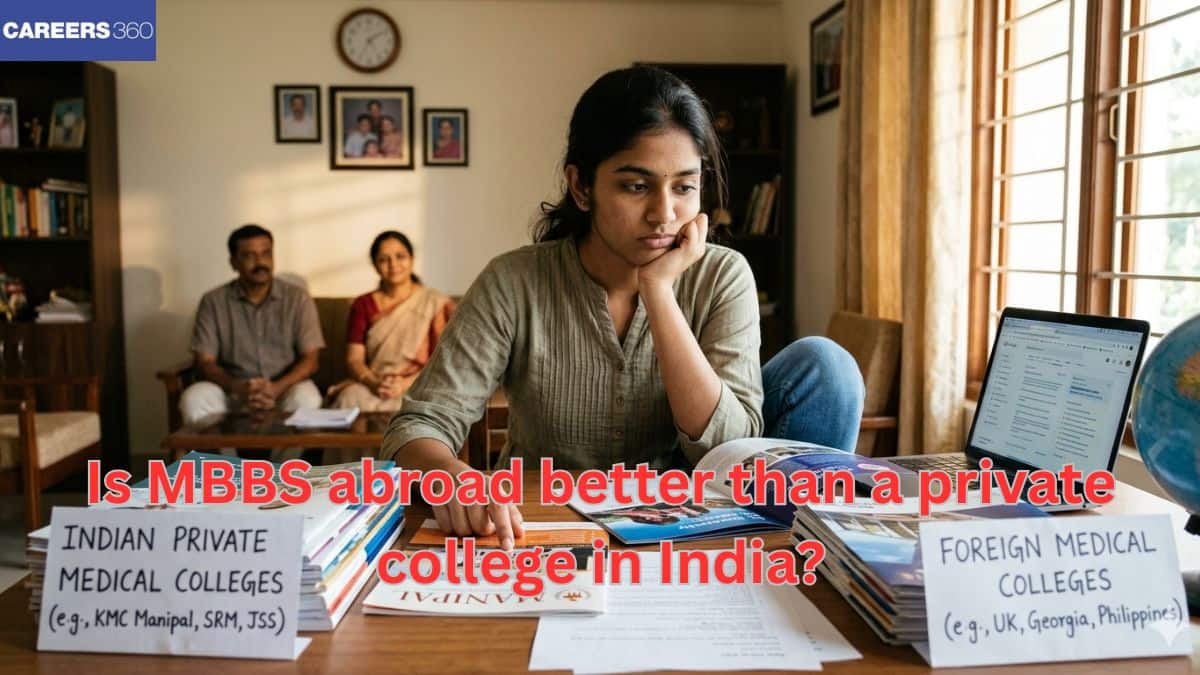
Indian students often choose to study MBBS abroad rather than enrolling in a private medical college. The difference does not only stem from the fee structure but also from the premium aspects that foreign colleges offer. Studying MBBS abroad offers high-quality academic standards, modern infrastructure and excellent clinical exposure. Despite these advantages, students are discouraged from pursuing MBBS abroad because they often lack advice and guidance on studying abroad. Here, we compare private and abroad medical colleges across all key aspects:
This Story also Contains
- Medium of Instruction
- Quality of Academic Standards: Indian Private Medical Colleges vs Abroad Medical Colleges
- Foreign medical colleges vs Indian private medical colleges: Fee structure
- Conclusion
Medium of Instruction
All private colleges in India use English as the primary medium of instruction. Countries across Europe and Asia are known for their reputed medical institutions, though they offer MBBS in their local languages. A few countries have incorporated English curricula in medical colleges to facilitate international students so they do not have to adapt to a foreign language. Moreover, a few colleges in Russia and China require students to learn the local language for clinical training and licensing purposes. So, students need to acknowledge these requirements before enrolling in a medical college or university.
Quality of Academic Standards: Indian Private Medical Colleges vs Abroad Medical Colleges
The quality of academic standards differs between private and overseas medical colleges. This is entirely due to the medical standards and academic register that these colleges possess. Medical colleges and universities are consistently ranked among the top medical institutions according to QS World Rankings. These rankings affirm the clinical standards and quality of academic programs in medical colleges, which most of the foreign medical colleges and universities adhere to.
Duration
The majority of medical colleges abroad offer MBBS courses with a duration of 6 years, including an internship programme, and often comply with NMC guidelines. On the other hand, all private medical colleges and universities in India have a duration of 5.5 years according to the NMC guidelines.
Clinical Practice
Clinical practice in foreign medical colleges and universities follows procedures and modern traditions, meeting current medical standards. Private medical colleges in India are more adapted to the Indian clinical environment. As hospital procedures, patient flow, and medical assistance differ between private and foreign medical colleges, students are advised to consider this aspect according to their preferences.
Also read -
Admission
While private medical colleges in India require NEET eligibility for admission, foreign medical colleges require the NEET score for a practising license in India. Admission to a foreign medical college does not require any NEET eligibility if the candidate wishes to practice in the country of study.
Also read -
Eligibility criteria:
Minimum Age required: candidates should be at least 17 years of age at the time of admission.
Candidates should have at least 50% aggregate marks in biology, physics and chemistry.
Entrance Exam: The entrance examinations for admission to foreign medical schools vary by country. So, candidates have to meet each country’s entrance exam requirements to be eligible for MMBS abroad.
IMAT: International Medical Admission Test is an exam conducted by the Educational Ministry of Italy for students who are planning to pursue a medical course
MCAT: Medical College Admission Test is conducted in the USA and Canada. All the students need to clear their pre-medical course to appear for this exam
NMAT: National Medical Admission Test is conducted in the Philippines after completing a pre-medical course for admission to the MD course.
UCAT: Universal Clinical Aptitude Test is a test conducted in both the UK and Australia to test candidates’ efficiency after their pre-medical course for admission to medical colleges.
CSCA: China Scholastic Competency Assessment is a test conducted in China by the Educational Ministry of China to evaluate students’ background knowledge in maths, biology, physics and chemistry.
TMS & TestAS: Test for Medical Studies and Test for Academic Studies are tests for students who intend to pursue a medical course in Germany. TMS is for the medical course, while TestAS is for every student to assess general and subject-related abilities.
Also read - Entrance exams for Studying MBBS in Abroad 2025
Practising in India
Indian Graduates
Students studying in Indian private medical colleges can obtain a license to practice without any complications. As of 2026, there is no exam to qualify MBBS graduates for medical practice in India.
Foreign Medical Graduates: As of 2026, students graduating from a foreign medical college take the FMGE (Foreign Medical Graduate Exam) test to qualify for obtaining a license in India. Moreover, students should also comply with the NMC guidelines, which are a prerequisite for this exam.
Also read
Fee Structure
The fee structure of medical colleges is a major factor that determines candidates' college selection, as affordability matters most. Compared to foreign medical colleges, Indian private medical colleges charge higher tuition fees, which is why Indian students prefer to study MBBS abroad. The fees in Indian private medical colleges are charged according to these quotas:
Government quota: Students who clear NEET with the required cutoff can enrol in the seats allotted to the government quota. These seats typically cost 50k - 7 lakhs per year.
Management Quota: This quota is usually for students who fail to clear the NEET exam. In this quota, students pay 30 - 60 lakhs per year.
Also read -
Cheapest MBBS Colleges in the World: Top medical colleges, fees, tuition cost
Study MBBS abroad: Top medical universities & fees structure
Note: As per the NMC guidelines, private medical colleges in India allots 15% of seats to the Government Quota. Students who clear NEET can enrol in these seats. Moreover, NEET marks play a major role in deciding the fee structure of the course, as each set of marks defines the fee for a category. That said, students who do not clear the NEET exam need to enrol in the management quota
Here is a detailed structure of Indian private medical colleges in a few states:
State | Annual Tuition Fee Range | Total Estimated Cost | Key Features |
Kerala | ₹10L – ₹15L | ₹60L – ₹1.0Cr | Most affordable due to strict state fee caps. |
West Bengal | ₹6L – ₹12L | ₹35L – ₹70L | Among the lowest private MBBS options in India. |
Karnataka | ₹11L – ₹25L | ₹70L – ₹1.5Cr | Popular "Open" state; good balance of cost and quality. |
Telangana | ₹11.5L – ₹15L | ₹60L – ₹80L | Category-B seats are open to non-domicile candidates. |
Andhra Pradesh | ₹13.2L – ₹14L | 75L – ₹1.2Cr | Category-B fees are fixed by state government orders. |
Uttar Pradesh | ₹10.7L – ₹19L | 70L – ₹1.1Cr | Many "Open" seats; no domicile required for management quota. |
Tamil Nadu | ₹9.6L – ₹16L | ₹60L – ₹70L | Competitive fees; private colleges are generally open nationally. |
Bihar | ₹12L – ₹18L | ₹75L – ₹1.2Cr | Fees for self-financing colleges recently hiked. |
Rajasthan | ₹18L – ₹30L | ₹1.1Cr – ₹1.5Cr | One of the more expensive states for management seats. |
Maharashtra | ₹11L – ₹30L | ₹1.2Cr – ₹1.8Cr | Institutional quota can be significantly higher than standard private fees. |
Haryana | ₹12L – ₹25L | ₹80L – ₹1.2Cr | Often includes a mandatory 7.5% annual increment. |
Madhya Pradesh | ₹6.6L – ₹11.5L | ₹45L – ₹70L | State-regulated fee structures apply to private colleges. |
Foreign medical colleges vs Indian private medical colleges: Fee structure
Countries like Russia, Georgia, Uzbekistan and Kazakhstan offer English-taught MBBS courses at low fees. Compared to the above-mentioned IDespitendian states, the difference in the fee structure between foreign medical colleges and Indian private medical colleges remains as low as 30 to 70 lakhs INR, as foreign medical colleges’ fees are much lower. Moreover, Indian students often choose foreign medical colleges over Indian private medical colleges because they are much more affordable.
Conclusion
Indian students seeking affordable MBBS programmes abroad should choose foreign medical colleges over Indian private medical colleges. Despite unfamiliarity, these foreign colleges are known for their academic excellence, experienced teaching staff and high-quality clinical exposure. Moreover, Indian students do not need to qualify for the NEET, as most foreign medical colleges enrol students based on foreign entrance exams and 12th-grade scores. For these reasons, studying MBBS abroad remains a better option.
Frequently Asked Questions (FAQs)
A category is for students who clear the NEET cutoff marks. The tuition fees for this category remain low as directed by the state government. The B category is for students who do not clear the NEET exam. Typically, the fees for these students remain high compared to the A category.
The C category is usually defined as a management quota. It is for students who can pay a higher tuition fee.
For students who fail to clear the NEET exam, foreign medical colleges are the best choice in terms of affordability and overall educational quality.
Although the NMC has considered donation fees illegal, some of the medical colleges in India never cease to charge donation fees. Moreover, regulations for medical tuition fees vary by state. Cheap medical colleges in India
