


GMAT Exam Pattern 2026: Sections wise Weightage, Marking Scheme
It is important to know the pattern and syllabus of the GMAT exam before beginning the GMAT exam preparation. The GMAT Exam Pattern is divided into 64 questions divided into three sections: 21 questions in the quantitative reasoning section, 23 questions in the verbal reasoning section, and 20 questions in the data insights section. The GMAT exam duration is 2 hours 15 minutes (with one 10-minute optional break).
This Story also Contains
- Key Features of the GMAT Exam
- GMAT Exam Pattern 2026
- Details of GMAT Pattern 2026
- GMAT Sections
- GMAT Exam Structure 2026
- GMAT Pattern 2026: Section-wise
- What is the Computer Adaptive Test?
- GMAT Score 2026
- GMAT Preparation Tips 2026
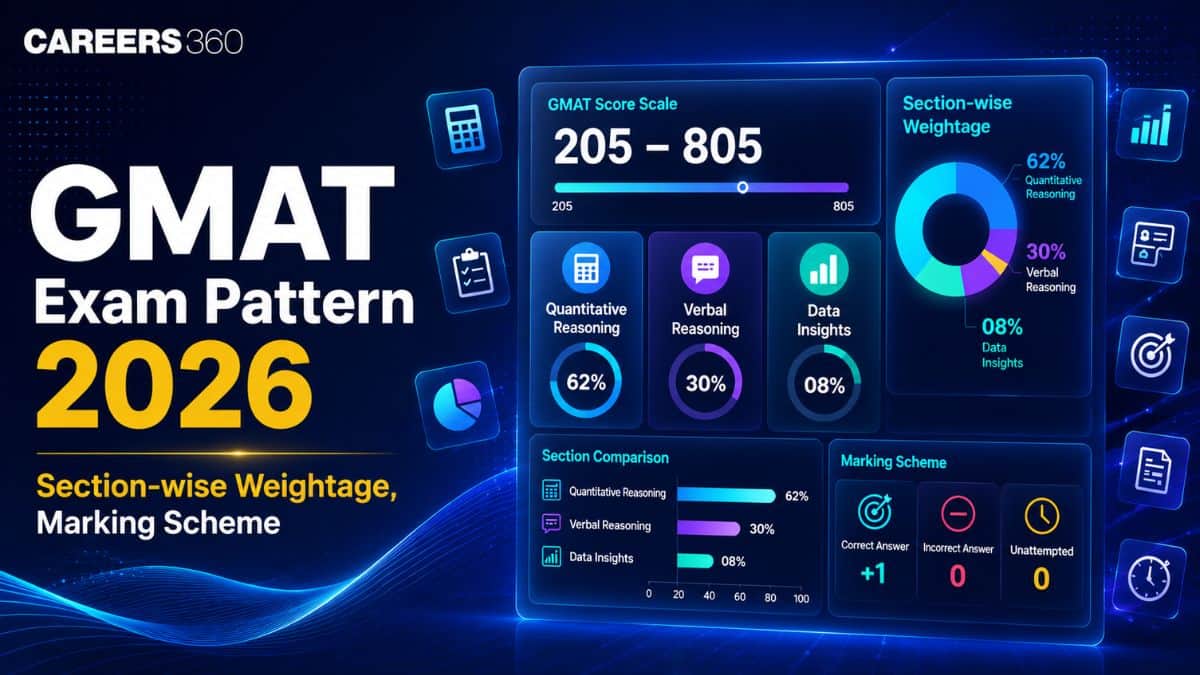
The GMAT 2026 exam pattern aims to evaluate the problem-solving ability of the applicant, challenging critical thinking, and testing data analysis skills, which are key elements for applying to graduate business programs abroad. The GMAT exam 2026 offers test-taker-friendly features and flexible score-sending options. To learn more about the GMAT exam, candidates should thoroughly familiarise themselves with the latest GMAT pattern 2026. Read the full article to learn more about the pattern of the GMAT test.
Latest Updates:
Recently, GMAC has announced a significant change in its policy: The long-standing 8-attempt lifetime limit for the GMAT is no longer in effect. From now on, there is no lifetime limit for the GMAT exam.
The other aspect that should be kept in mind is that even after removing the lifetime limit, a maximum of 5 attempts remains valid within a rolling 12-month period.
Key Features of the GMAT Exam
The GMAC offers candidates control of their testing experience with the following key features:
Question Review & Edit
With the help of the question review and edit tool, candidates can edit their answers later for each section. This way, you don't need to devote a lot of time to the question you are unsure about, as you can go back to these questions later and update them once you have answered all other questions. Here is how this works:
- It is possible for the candidates to bookmark the questions that they would like to review later.
- Once a section is done, click on the Question Review & Edit screen for that section.
- There will be a numbered question list that will have all the questions you have bookmarked.
- You can review as many questions as you want and can edit up to three (3) answers.
Select Section Order
There is no restriction on the order of the GMAT exam; you can answer the sections in any order. You can even decide when you want the optional break. This personalised testing experience lets the candidate perform at their best.
Flexible Score Sending
You can choose which schools you want to receive your free score reports from after the test is done. So, you can take the test without worrying about the scores.
Detailed Results Delivered Fast
Candidates get a detailed official score report for the GMAT exam, including:
- Performance by Section
- Performance by Program & School
- Performance by Content Domain (subject area), Question Type, and Skills
- Time Management
GMAT Exam Pattern 2026
The table below shows the latest GMAT exam pattern.
GMAT Focus Edition Section | Number of Questions | Time | GMAT Focus Edition Score Range |
|---|---|---|---|
Quantitative Reasoning (QR) | 21 Questions | 45 Minutes | 60-90 (1-point Increment) |
Verbal Reasoning (VR) | 23 Questions | 45 Minutes | 60-90 (1-point Increment) |
Data Insights (DI) | 20 Questions | 45 Minutes | 60-90 (1-point Increment) |
Total | 64 Questions | 2 Hours + 15 Minutes | 205-805 (10-point Increment) |
Breaks | - | 1 Optional Break of 10 Minutes |
Details of GMAT Pattern 2026
A new pattern has been introduced by the GMAC that replaced the previous standard GMAT exam syllabus and pattern. Some new features have been introduced, which are:
The new GMAT format 2026 is designed to be efficient, flexible, and insightful.
GMAT can be attempted throughout 365 days online by computer only.
The GMAT exam duration is 2 hours and 15 minutes for the new GMAT format 2026.
GMAT exam syllabus has been updated to three major sections - Verbal, Quantitative, and Data Insights for the 2026 session.
The candidate can bookmark questions in the exam and also have a chance to edit up to 3 answers per section.
There is no particular sequence in the GMAT pattern 2026; the candidate can attempt any section in any sequence.
Also Check:
GMAT Sections
The new GMAT pattern 2026 has only an optional break of 10 minutes. As the new GMAT format 2026 has a reduced exam duration of 2 hours, the break period is shortened. Candidates with disabilities are provided with additional time on prior request at the time of GMAT registration.
Section | No. of Questions | Time Limit |
Quantitative Reasoning | 21 | 45 min |
Verbal Reasoning | 23 | 45 min |
Data Insights | 20 | 45 min |
Optional break (10 minutes) - Anytime during the exam | ||
Total | 64 | 2 hours 15 min |
GMAT Exam Structure 2026
According to the new GMAT exam structure 2026, there is no fixed section order for the GMAT exam 2026. Candidates can choose the best order that suits them. Candidates can attempt multiple mock tests to decide the best-suited order for the GMAT exam structure 2026.
GMAT Pattern 2026: Section-wise
A new data insights section has been added, and the remaining GMAT exam syllabus is unchanged. The latest GMAT syllabus is mentioned below. The GMAT syllabus includes the following:
Quantitative Reasoning
Verbal Reasoning
Data Insights
Each section will have some time limits, and the test will be a computer-adaptive one. The indicative syllabus of the GMAT exam structure 2026, along with the other details, is explained below.
GMAT Exam Pattern for Quantitative Reasoning
The quantitative section of the new GMAT format 2026 measures the algebraic and arithmetic foundational knowledge application for problem-solving. 21 questions are asked in this section. The skills required to solve these GMAT questions are logical skills and analytical skills.
GMAT Exam Pattern for Verbal Reasoning
The verbal section of the GMAT 2026 pattern measures the candidate's ability to read and comprehend texts and reasons and evaluate arguments. A total of 23 questions are asked from this GMAT verbal syllabus.
The question types include,
Reading Comprehension
Critical Reasoning
In the reading comprehension questions of the GMAT pattern 2026, the candidate's reading skills, such as main idea, inference application, and logical structure, are tested. Critical reasoning questions consist of short reading passages of less than 100 words. Based on the passage, questions are asked.
GMAT Exam Pattern for Data Insights
The data insights section of the GMAT format 2026 measures the candidate's ability to analyze and interpret data in real-world business scenarios. The section consists of 20 questions.
The question types include,
Data Sufficiency
Multi-Source Reasoning
Table Analysis
Graphics Interpretation
Two-Part Analysis
In the two-part analysis, there could be problems of both quantitative and verbal, or a combination of both. This GMAT pattern 2026 of the data insights section is intentionally versatile to cover a wide range of concepts.
What is the Computer Adaptive Test?
The GMAT 2026 is a computer-adaptive test and is conducted around 360 days of the year. The GMAT exam pattern 2026 includes a few test modalities. Each question in the GMAT paper pattern is computer-adaptive, which means the difficulty level of the test changes based on the ability of the candidates to answer the questions. The computer-adaptive nature of the GMAT 2026 pattern assesses the candidate’s potential with a high degree of precision.
For example, in the GMAT sections on verbal reasoning, the first question will be of medium difficulty. As the candidate answers the question, the computer scores the answer and uses it along with the answer to any preceding question to select the next question.
If the first question is answered correctly, the next question will be a harder one. And, if the first question is answered incorrectly, the next question will be of moderate difficulty. This process continues until the candidate completes the section. The benefit of having a computer-adaptive GMAT 2026 pattern is that the candidate can show their potential and hold on to the sections of verbal and quantitative ability.
GMAT Score 2026
The GMAT exam total marks scale is 205-805, and the scores end with the last digit 5 in the GMAT Score Report. Knowing the new GMAT format 2026 and understanding the types of questions and duration of various sections is an important step before taking the GMAT exam to score high.
GMAT Exam Pattern: Section-Wise Weightage
Section | Score Range | Score Interval |
Quantitative Reasoning | 60-90 | 1 |
Verbal Reasoning | 60-90 | 1 |
Data Insights | 60-90 | 1 |
Total | 205-805 | 10 |
GMAT Preparation Tips 2026
The GMAT exam is considered to be one of the toughest exams for candidates interested in studying abroad for higher studies. GMAT format 2026 assesses the English language abilities of candidates who want to pursue their future in B-school studies.
Therefore, GMAT preparation is considered to be very daunting for applicants. However, a strategic study plan, effective study materials, and preparation tips may accelerate their GMAT preparation levels. Some of the GMAT preparation tips are:
Set a target score.
Make a study schedule.
Get the GMAT preparation apps.
Without a calculator, practice basic calculations.
Take the online practice tests at a normal pace.
The best month or time to take the GMAT exam.
Also Read:
Frequently Asked Questions (FAQs)
The new GMAT pattern includes:
- Three major sections, namely, Data Insights (DI), Verbal Reasoning (VR), and Quantitative Reasoning.
- The GMAT exam duration is 2 hour 15 minutes, 45 minutes for each section.
- The essay has been removed.
- All the questions will be multiple-choice questions.
To prepare for the GMAT 2026 exam, first, students must be well aware of the exam syllabus and pattern. They must practice regularly and get help from mentors, teachers, and professionals for doubts and exams. They must also prepare using official study materials.
Candidates can appear for the GMAT exam throughout the year. However, students are advised to start preparing 3-6 months before targeting a test date. Choosing the right time for taking the GMAT exam depends on several factors:
Target schools: Candidates must apply for GMAT registration after considering the deadline of their targeted B-school.
Preparation time: Analyse the current skills and set a realistic study timeline.
GMAT Exam Format preference: Choose the right GMAT exam pattern between the standard GMAT exam pattern and the new GMAT Focus Edition.
GMAT fee structure 2026 depends on location and format.
Standard GMAT:
- Most countries: USD 275 (Test-Centre) and USD 300 (At Home)
- Select developing countries: USD 250 (Test-Centre) and USD 275 (At Home)
However, candidates might be required to pay an additional GMAT fee for rescheduling, score reinstatement, and late registration.
GMAT exam 2026 is available throughout the year. Candidates can register for the GMAT exam all year round. If you want to appear for the GMAT during the fall, you can book the slot for up to 6 months before the desired exam date.
Each section of the GMAT is scored on a scale of 60 to 90 points. The breakdown of the sections are : quantitative section contains 21 questions, verbal reasoning 23, and data insights 20.The total score ranges between 205 and 805.
No, it is not easy to get a score of 750 in the GMAT; however, it is not an impossible task. Students with an organised study plan, thorough understanding of all the topics, and practice of sample papers can eventually help them to score 750 or more in the GMAT. The only key to achieving this score is consistency, practice, and determination.
This score is considered to be on the lower side of the score range. Hence, with this score, it might get challenging for applicants to apply to their desired universities. A good practice session every day will help the applicants to achieve a higher score.
